
 by artencordoba
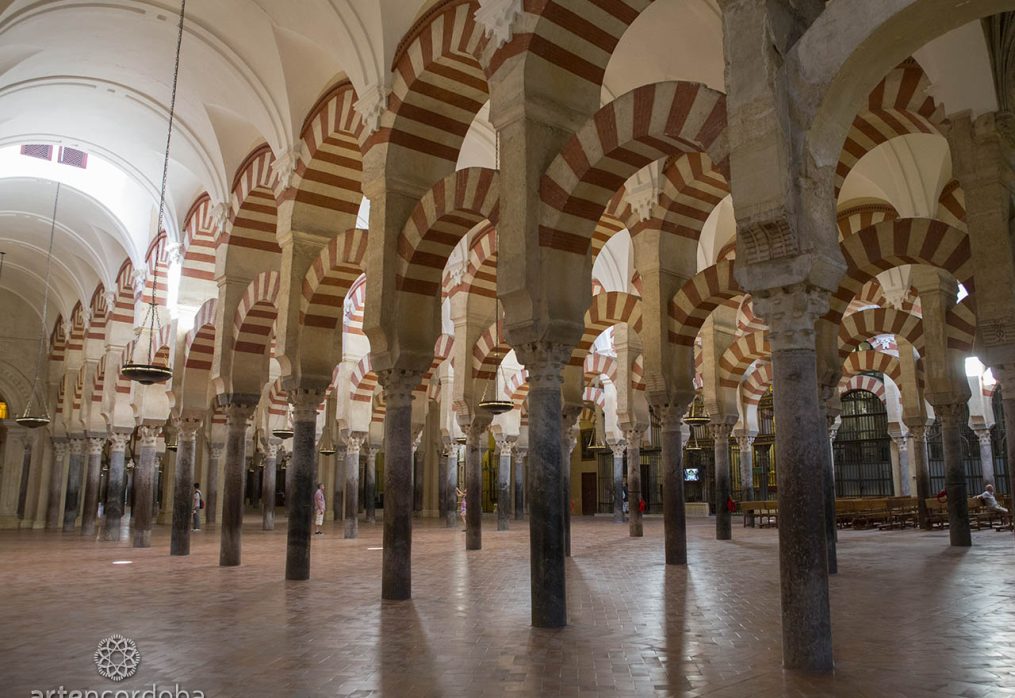
When you walk through the eastern aisles of the Mosque of Cordoba today, you are standing in the work of Almanzor, the man who ruled al-Andalus in the name of Caliph Hisham II and who commissioned the last and largest extension of the building. His project, begun around 987-988, turned the Mosque into one of the largest temples in the Islamic world of its time. Here is who Almanzor was, why he extended the Mosque to the east and which details of his work you can spot during your visit.
Who was Almanzor, the ruler who governed in the caliph’s name
Muhammad ibn Abi Amir, known as al-Mansur (“the Victorious”) and remembered in Spanish as Almanzor, was born around 938 in the south of al-Andalus into an Arab family of jurists. He came to Cordoba to study law and rose through the caliphal administration until he became a trusted figure in the household of al-Hakam II.
When al-Hakam II died in 976, his heir, Hisham II, was still a child. Almanzor removed his rivals at court and took the post of hajib (roughly a chief minister). For more than two decades the caliph was reduced to a symbolic role while Almanzor governed in practice, led the armies and even built his own palace city, Madinat al-Zahira, east of Cordoba.
The man of the military campaigns
His reputation in the Christian kingdoms came from his military raids, which the chronicles number at more than fifty. The best remembered is the 997 campaign against Santiago de Compostela: according to tradition, the bells of the Galician cathedral were carried to Cordoba by Christian captives and adapted as lamps for the Mosque. More than two centuries later, after Ferdinand III conquered the city in 1236, the journey was reportedly made in reverse. Almanzor died in 1002 in Medinaceli, during one of his campaigns.
Almanzor’s extension: why the Mosque grew to the east
At the end of the 10th century Cordoba was one of the most populous cities in Europe, and despite earlier extensions the Mosque was too small for Friday prayers. Until then the building had always grown southwards, towards the river, as we explain in our post on the origin of the Mosque and the work of Abd al-Rahman I. But that route was exhausted: the Guadalquivir was too close and the caliphs’ palace stood to the west.
The only way out was east. Almanzor added eight new aisles along the entire eastern side of the building, from the north wall to the qibla wall, and enlarged the ablutions courtyard in the same proportion. The result was a total area of roughly 23,000 square metres, the size the building still has today.
A mihrab that was no longer in the centre
Growing sideways had a consequence that many visitors notice without being able to explain it: the mihrab of al-Hakam II, which used to sit on the central axis of the prayer hall, ended up shifted to the west. Almanzor did not build a new mihrab, so the holiest spot in the building is no longer aligned with its centre. To understand how each phase fits together, read our guide to the architectural evolution of the Mosque of Cordoba.
How to recognise Almanzor’s work during your visit
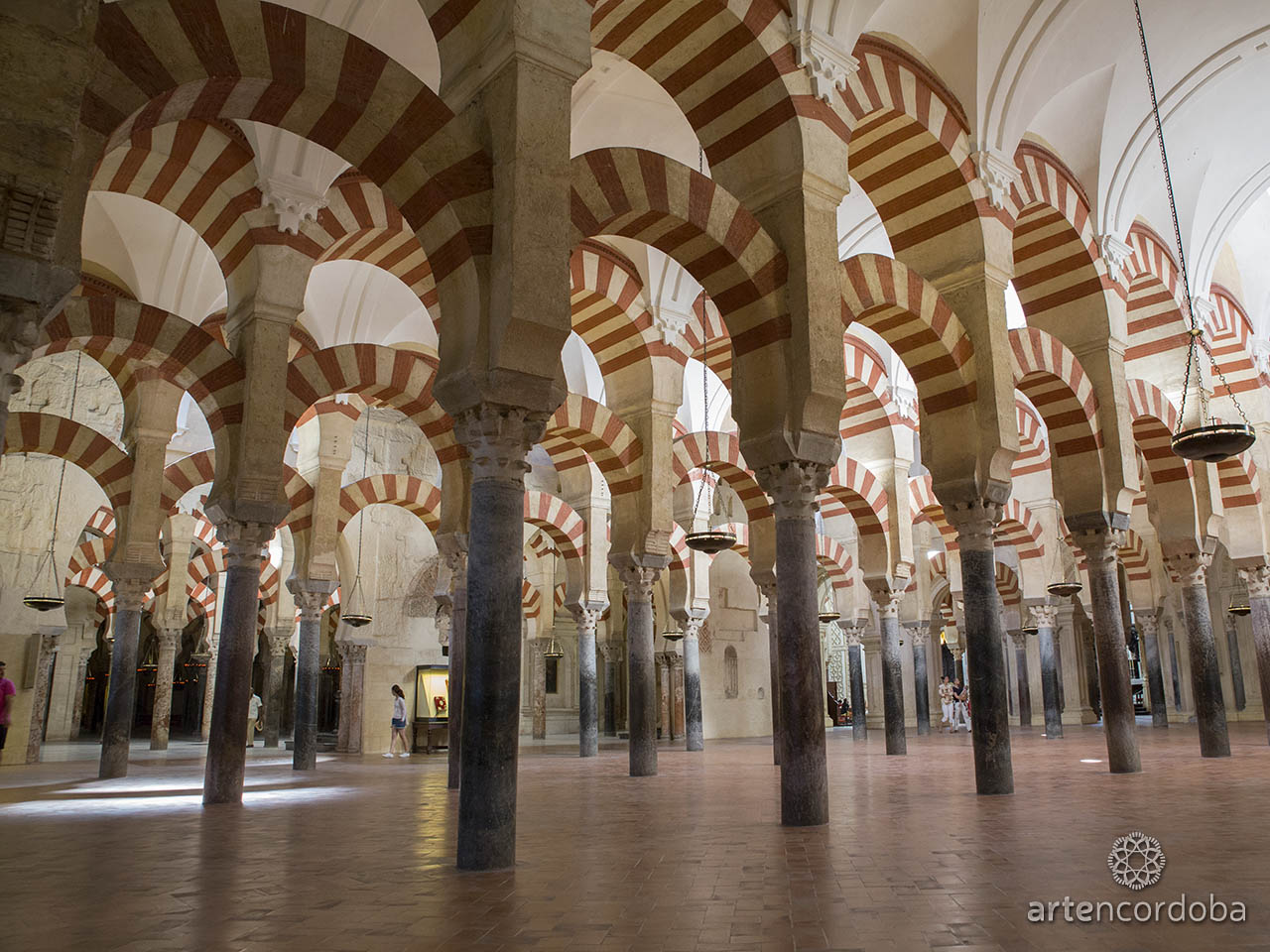
At first glance Almanzor’s aisles look like a natural continuation of the forest of columns. He kept the system of superimposed horseshoe and round arches devised in the 8th century, which gives the whole hall its unity. Look closely at the details, though, and the difference shows.
Painted arches instead of brick
In the oldest phases the two-tone effect of the arches comes from alternating stone and brick voussoirs. In Almanzor’s extension, by contrast, the voussoirs are stone and the red is painted on to imitate the original effect. It was a faster and cheaper solution, showing that the aim was to add space rather than compete in luxury with al-Hakam II. You will find more about this system in our article on the arches of the Mosque of Cordoba.
More uniform columns and capitals
The earliest phases reused Roman and Visigothic columns and capitals from very different sources. In Almanzor’s area, pieces carved specifically for the project dominate, simpler and more repetitive in style. The light changes too: today this part of the hall is slightly brighter and usually less crowded, a good spot to take in the perspective of the arcades calmly.
The courtyard and the eastern façade, also Almanzor’s work
The extension was not limited to the prayer hall. The courtyard grew eastwards in parallel, and a large cistern was built beneath it to store water for ablutions. That space is today’s Courtyard of the Orange Trees, which every visitor crosses on the way in.
On the outside, the extension created the façade facing Calle Magistral González Francés, with a series of doorways decorated with multifoil arches, latticework and ataurique plasterwork. Many of them were restored in the early 20th century by the architect Ricardo Velázquez Bosco, so it is worth looking at them knowing they mix original pieces with reconstructions.
Frequently asked questions about Almanzor and the Mosque of Cordoba
When was Almanzor’s extension built?
Work began around 987-988, during the nominal caliphate of Hisham II, when Almanzor was the real ruler of al-Andalus. It was the fourth and last major Islamic extension of the building, after the foundation by Abd al-Rahman I and the extensions of Abd al-Rahman II and al-Hakam II. With it, the Mosque reached the size it still has today.
Why did Almanzor extend the Mosque to the east?
Because growing south was no longer possible: the qibla wall was very close to the Guadalquivir river and the ground sloped down towards the bank. To the west stood the caliphal palace. The only free direction was east, where Almanzor added eight longitudinal aisles and enlarged the courtyard in the same proportion.
Can you see Almanzor’s area when visiting the Mosque?
Yes. Almanzor’s aisles take up the whole eastern side of the prayer hall and are included in the general visit. You can recognise them by their painted voussoirs and their more uniform columns. With a guide it is much easier to find the line where al-Hakam II’s work ends and Almanzor’s begins.
Is it true that the bells of Santiago ended up in the Mosque?
That is what the chronicles say: after the 997 campaign against Santiago de Compostela, the bells of its church were taken to Cordoba and used as lamps in the Mosque. According to tradition, Ferdinand III returned them to Santiago after conquering Cordoba in 1236. The episode is part history and part legend.
Almanzor’s extension is the best proof that the Mosque is a living building, made in layers over the centuries. If you want to learn to tell them apart on site, on our guided tour of the Mosque of Cordoba we show you how to read each phase, from Abd al-Rahman I to Almanzor.


