
 by artencordoba
The Villaviciosa Chapel is one of the places in the Mosque of Córdoba where the building makes the most sense: 10th-century caliphal arches and, beneath them, the memory of the cathedral’s first main chapel. The high altar stood here after the Christian conquest of 1236, and nothing built by al-Hakam II had to be demolished to make room for it. Here is what it was, where the name comes from and how to look at it on your visit.
What is the Villaviciosa Chapel?
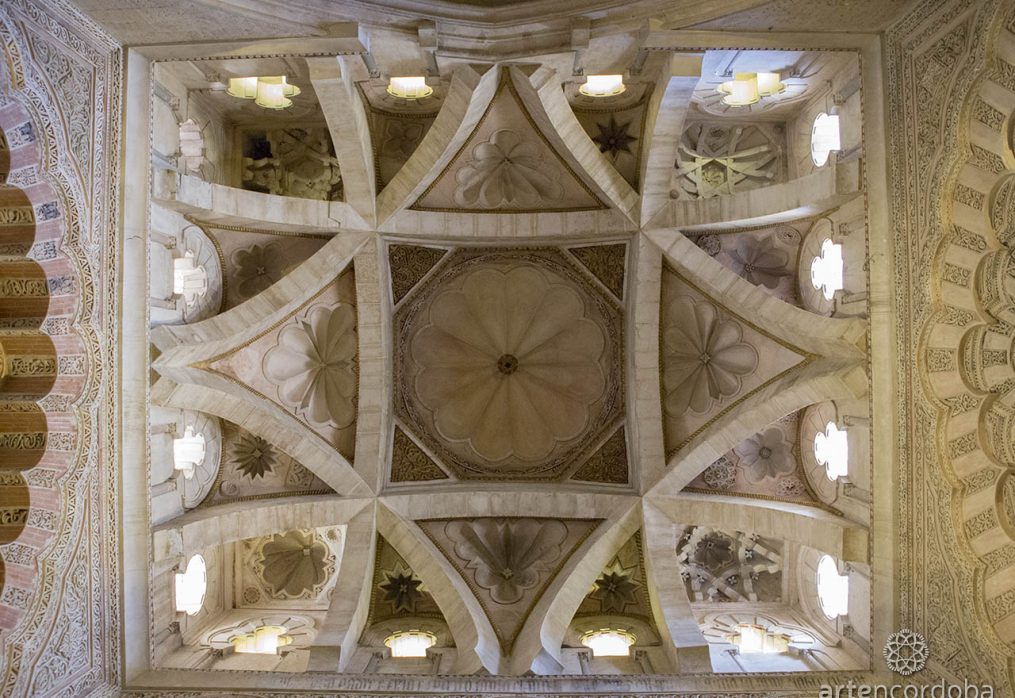
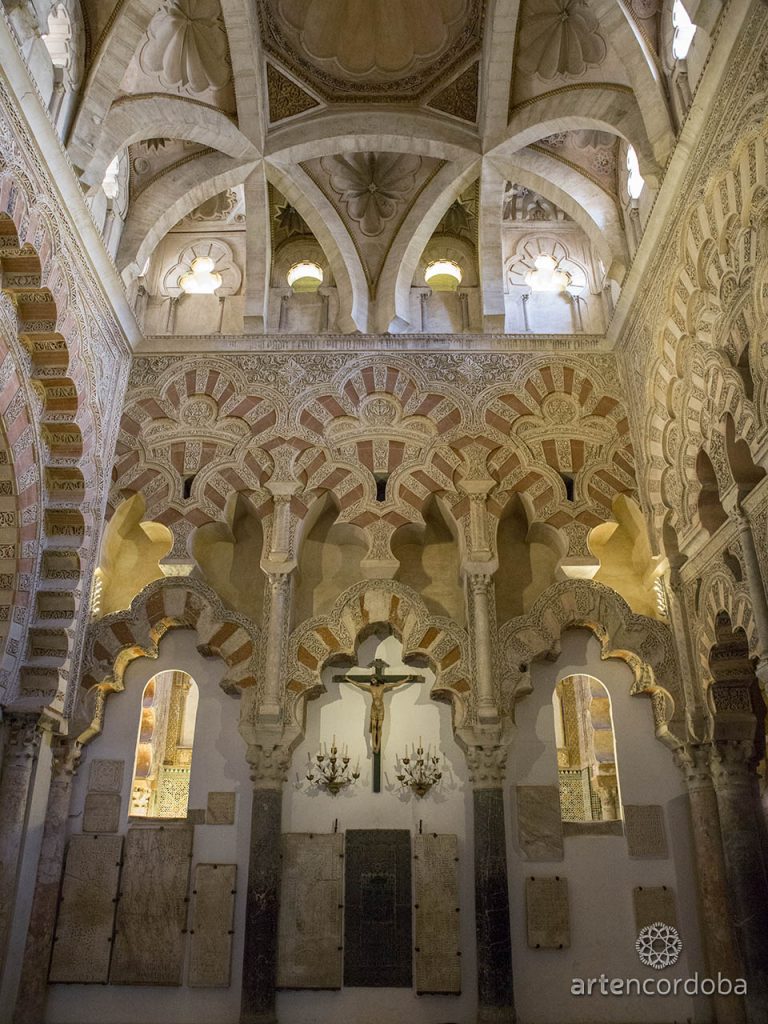
The name refers to the space that served as the cathedral’s original main chapel. It brings together two very different periods: the first of the skylights that al-Hakam II opened in his extension, just before the maqsura, and the large Gothic nave added at the end of the 15th century.
The title of this article needs one clarification: this is not a separate church built inside the Mosque, but an existing Islamic space adapted to a new use. That is exactly what makes it interesting. Instead of raising a new building, the cathedral’s first custodians reused the most prestigious area they found. It is a key chapter in the story of how the Mosque became a cathedral.
From al-Hakam II’s skylight to the main chapel
A 10th-century caliphal skylight
Al-Hakam II’s extension, begun in the 960s, needed light. The aisles had grown longer towards the south and the interior risked sinking into shadow, so skylights covered with ribbed domes were opened. The Villaviciosa skylight announces the arrival at the maqsura and the mihrab, working as a kind of solemn threshold.
Around it are the multifoil, interlacing arches that visitors photograph so often today. To see how that solution evolved, read our article on the arches of the Mosque of Córdoba. A few decades later, the eastern aisles of Almanzor’s extension would change the scale of the complex for the last time.
1236: the altar under the skylight
On 29 June 1236, after Ferdinand III conquered the city, the building was consecrated for Catholic worship. The high altar was placed under the skylight, a privileged spot for both its light and its richness. For more than two centuries the cathedral worked this way, with few structural changes: Christian liturgy adapted to Andalusi architecture, not the other way round.
Íñigo Manrique’s Gothic nave
Change came between 1486 and 1496, under Bishop Íñigo Manrique, with the construction of a large basilica-style Gothic nave, articulated by pillars and pointed transverse arches. It was covered by a gabled timber roof, with coffers bearing plant motifs and Latin and Greek inscriptions referring to Jesus the Saviour.
That ceiling stayed hidden under vaults for centuries, until the architect Ricardo Velázquez Bosco recovered it in the 20th century. The role of main chapel eventually passed to the great Renaissance transept, built over the 16th century and brought into use at the start of the 17th.
Why is it called the Villaviciosa Chapel?
The name is not medieval. According to research by Teresa Laguna Paúl, it is documented from 1698, long after the space had stopped being the main chapel. It is usually linked to Our Lady of Villaviciosa, a devotion deeply rooted in the diocese of Córdoba, although the monument’s official website does not detail the origin of the name, so that explanation should be treated with caution.
What is clear is that the names of this corner have changed along with its use. That is why older texts may call it the old or primitive main chapel: it is the same place.
What the chapel kept hidden: frescoes and the Royal Chapel
The frescoes of Alonso Martínez
In 1351 the painter Alonso Martínez signed a cycle of saints and kings with Italo-Byzantine influence. The 19th-century restorations, which removed later plasterwork to reveal the Islamic elements again, brought part of those paintings to light, although the cycle did not remain in place. Only a Head of Christ survives today, on display at the Museum of Fine Arts of Córdoba. There is more in our article on the hidden frescoes of the Mosque-Cathedral.
The neighbouring Royal Chapel
Right beside this space stands the Royal Chapel, completed in 1371 at the wish of Henry II of Castile as a pantheon for Ferdinand IV and Alfonso XI. Its Mudéjar decoration shows that Christian kings did not merely respect the Andalusi language of forms: they admired it and made it their own.
How to see the Villaviciosa Chapel on your visit
You will come across it as you walk towards the mihrab, at the heart of al-Hakam II’s extension. These tips will help you make the most of it:
- Look up first: the ribbed dome and the light falling through the skylight explain why this spot was chosen.
- Then follow the arches: pick out the multifoil shapes and see how they interlace into an almost textile pattern.
- Look for the contrast: compare the caliphal work with the adjoining Gothic nave and the Renaissance transept that replaced it.
- Don’t rush: check the Mosque’s opening times and prices, and bear in mind that access to some areas may be limited for conservation.
Frequently asked questions about the Villaviciosa Chapel
What was the Villaviciosa Chapel?
It was the first main chapel of Córdoba Cathedral. It occupies the space of the skylight from al-Hakam II’s extension, next to which a Gothic nave was added at the end of the 15th century. The high altar stood here after the building was consecrated for Catholic worship in 1236.
Who built the Villaviciosa Chapel?
The Islamic part belongs to the extension ordered by Caliph al-Hakam II in the 10th century. The Gothic nave was raised between 1486 and 1496, under Bishop Íñigo Manrique. It is therefore a space built in layers, which is why caliphal arches and Gothic solutions sit side by side.
Why is the Villaviciosa Chapel important?
Because it shows how the building was adapted to Christian worship without destroying its Islamic architecture. Its skylight is also one of the finest examples of Cordoban caliphal art, with a ribbed dome and interlacing arches that influenced later Andalusi architecture.
How is it different from the Royal Chapel?
They are adjoining spaces with different purposes. The Villaviciosa Chapel was the original main chapel, used for the cathedral’s principal worship. The Royal Chapel, completed in 1371 with Mudéjar decoration, was created as a pantheon for kings Ferdinand IV and Alfonso XI, whose remains were later moved elsewhere.
The Villaviciosa Chapel sums up centuries of coexisting architectures in just a few metres. To learn to read all those layers on site, join our guided tour of the Mosque of Córdoba.


